Real change begins by listening
Methodology
The STREEPI Five-Stage Inclusion Framework
From accessibility to participation. From policy to culture.
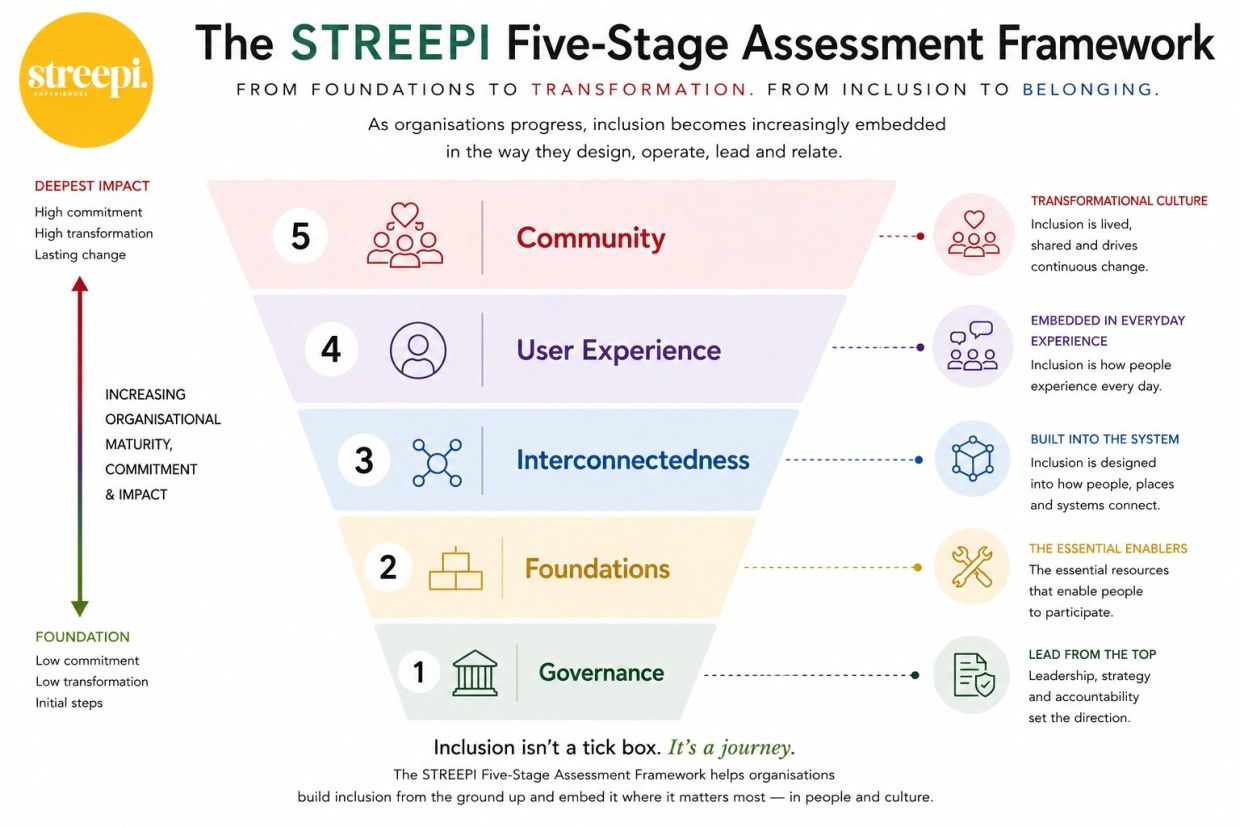
The working framework
The STREEPI Five-Stage Assessment Framework helps organisations move beyond compliance by embedding disability inclusion into leadership, operations and organisational strategy—creating stronger systems, better experiences and lasting value.
In detail
Stage 1 | Governance
Leading organisational commitment.
Sustainable inclusion requires more than good intentions. It depends on leaders who embed inclusion into organisational strategy, decision-making and accountability.
This stage examines how leadership, governance and policy work together to create a culture where inclusion is valued, supported and continuously improved. When leaders demonstrate commitment, inclusion becomes part of how the organisation thinks, acts and grows.
Is inclusion embedded understanding in the fundamental grounding of the organisation?
Stage 2 | The foundations
Every inclusion journey begins by ensuring people have the resources they need to participate. This includes physical accessibility, assistive technology, accessible information, reasonable adjustments and appropriate support.
While these resources remove immediate barriers, they are only the foundation. On their own, they do not create an inclusive organisation. Lasting inclusion requires organisations to move beyond individual accommodations and begin embedding participation into the way they design, operate and lead.
Do stakeholders have the resources they need to participate?
Stage 3 | Interconnectedness
Embedding inclusion by design.
Inclusive organisations don't rely on adaptations after barriers have been identified. They design environments, services and experiences that enable participation from the outset.
This stage explores how physical infrastructure, digital environments and organisational systems work together to create seamless, inclusive experiences. When inclusion is considered by design, organisations reduce barriers, improve independence and create better outcomes for everyone.
Is participation embedded as the norm into the physical design of the organisation?
Stage 4 | User experience
Embedding inclusion into everyday practice.
This stage examines the user experience of the organisation. It explores how people actually experience everyday operations, communication, service delivery, workflows and interactions.
By understanding the reality of the user experience, organisations can identify where systems work well, where barriers remain and where meaningful improvements can be made.
What is the user experience really like operationally?
Stage 5 |Community
Strengthening understanding, collaboration and participation.
An inclusive organisation is built on strong relationships. This stage explores how employees, customers, partners and communities understand, support and work with one another to create an environment where everyone can participate.
When relationships are built on trust, empathy and shared understanding, inclusion becomes part of everyday interactions, strengthening collaboration, belonging and long-term organisational success.
Do people understand, support and enable one another to participate?
The STREEPI Five-Stage Inclusion Framework is cumulative. Each stage builds on the one before it. While organisations may begin by improving accessibility and providing resources, lasting disability inclusion is achieved when inclusive design, operational practice, leadership and organisational culture work together to create meaningful participation
Copyright © 2026 Streepi - all Rights reserved
Deze website maakt gebruik van cookies.
We use cookies to analyze website traffic and optimize your website experience. By accepting our use of cookies, your data will be aggregated with all other user data.